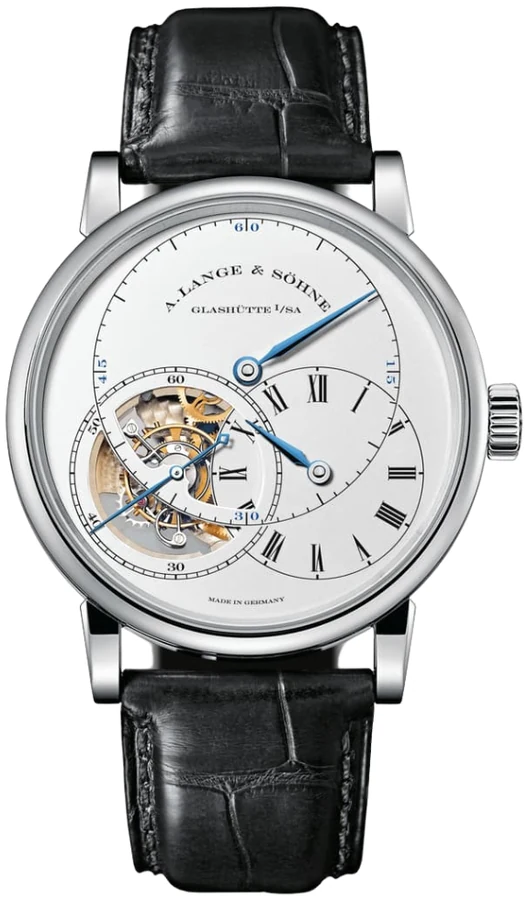
Few complications in horology carry the gravitational pull of the tourbillon. It is at once the most theatrical mechanism on a watchmaker's bench and the most contested. To traditionalists it is a 200-year-old answer to a problem largely solved. To the houses of Vallée de Joux and Geneva it is a stage on which to perform. To the modern collector it is, more often than not, a price tag with a rotating cage attached. All three positions are correct.
The Origin: Breguet, Paris, 1801
On 26 June 1801, Abraham-Louis Breguet, then 54 and already the most celebrated watchmaker in Europe, was granted a 10-year French patent for what he called the tourbillon regulateur, literally "whirlwind regulator". The problem he was solving was specific to pocket watches of the period. A pocket watch lives most of its life in a vertical position, suspended in a waistcoat. In the vertical, gravity acts unevenly on the balance wheel and hairspring, introducing positional error of several seconds per day.
Breguet's solution was elegant and audacious in equal measure. He mounted the entire escapement, the balance wheel, the hairspring, the lever and the escape wheel, inside a rotating carriage. As the carriage turned, typically once per minute, every position-induced error averaged itself out across a full revolution. A watch that ran fast at 12 o'clock and slow at 6 would now run, on average, accurately.
The first tourbillon watch was sold in 1805 to John Arnold, the English watchmaker. Breguet had retro-fitted his mechanism into a movement Arnold had originally made for him decades earlier, an explicit tribute. Between 1805 and 1823, the year of his death, Breguet made fewer than 40 tourbillon watches. Each was bench-finished by hand. Each is now a multi-million-dollar object at auction.
The tourbillon was patented to solve a problem that, on a wrist, no longer exists. That has not stopped it becoming the most recognizable complication in luxury watchmaking.
The Mechanics: What a Tourbillon Actually Does
A standard tourbillon assembly contains 60 to 90 individual parts and weighs less than half a gram. The cage itself is usually steel or titanium, finished by hand to mirror polish, and rotates around a fixed third wheel that drives the escapement. A 60-second rotation is conventional, though Greubel Forsey's Tourbillon 30 rotates in 24 seconds and Vacheron's Tourbillon 12 in 12 seconds, both for marginally faster averaging.
The Three Major Variants
- Conventional tourbillon. The cage sits between two bridges, one above and one below. The aesthetic is symmetric but partially obscured. This is the form Breguet used.
- Flying tourbillon. Cantilevered from beneath, with no upper bridge. The result is an unobstructed view of the cage from the dial side. Patented by Alfred Helwig of the German School of Watchmaking in 1920, it is now the dominant aesthetic choice in modern haute horlogerie.
- Multi-axis tourbillon. Two, three or four nested cages rotating on different axes. Greubel Forsey's Quadruple Tourbillon uses four. The technical justification is averaging in three dimensions rather than two. The honest reason is theatre.
An average automatic watch with a tourbillon adds 60 to 100 components to a base movement of 200 to 300. Assembly time multiplies accordingly. A Patek Philippe 5101P (a 10-day platinum tourbillon, since discontinued) reportedly required 120 hours of hand-finishing on the cage alone.
Why Buy a Tourbillon Today
The honest case against the modern wrist tourbillon is that it solves nothing. A wristwatch is moved through a constantly changing series of positions by the wearer's arm, which already averages out gravitational error. Modern hairsprings in silicon or Nivachoc, anti-magnetic and temperature-compensating, contribute orders of magnitude more accuracy than a rotating cage ever could.
So why is the tourbillon still made, and bought, in greater numbers than at any point in horological history?
- Demonstrated craftsmanship. Hand-finishing 70 microscopic parts to chronometric tolerances is genuinely difficult, and the open dial proves it.
- Visual movement. A tourbillon is the only complication that animates the dial continuously. The eye is drawn to motion in a way no power reserve indicator can match.
- Status. The complication's reputation is its function. A tourbillon on a wrist signals one of three things: substantial money, serious horological literacy, or both.
- Resale economics. Tourbillons from the right houses (Patek, AP, Breguet, Greubel Forsey) tend to retain value better than equivalent-priced complications. The market reads them as scarce.
The Watches That Define the Modern Tourbillon
Breguet Classique Tourbillon 5367
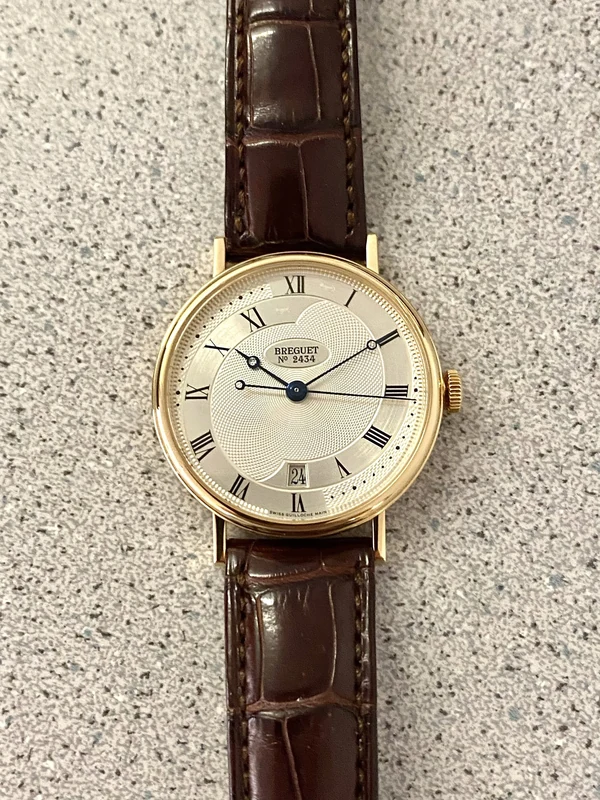
The reference that best honours the inventor. A 41 mm rose-gold case, hand-engraved guilloché silver dial, off-centred sub-dial at 12, and a peripheral oscillating weight to keep the tourbillon view unobstructed. Calibre 581. Around 0.13% of Swiss-made watches contain a tourbillon. This is the one most directly descended from the 1801 patent.
Audemars Piguet Royal Oak Tourbillon Extra-Thin (26522)
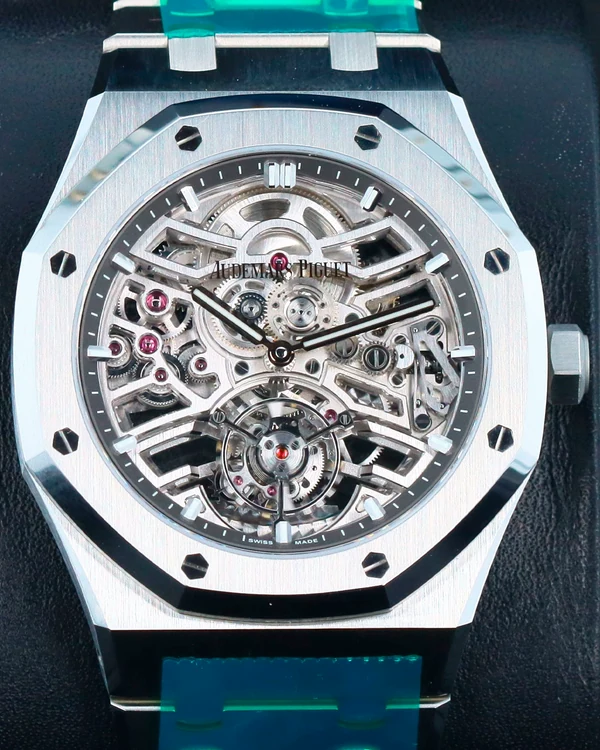
The flying tourbillon engineered into the thinnest Royal Oak case AP makes. Calibre 2968, 8.1 mm thick, a feat of micro-engineering disguised as a sports watch. The current 41 mm titanium reference traded at retail around CHF 220,000 and on the secondary market substantially higher.
Patek Philippe 5395
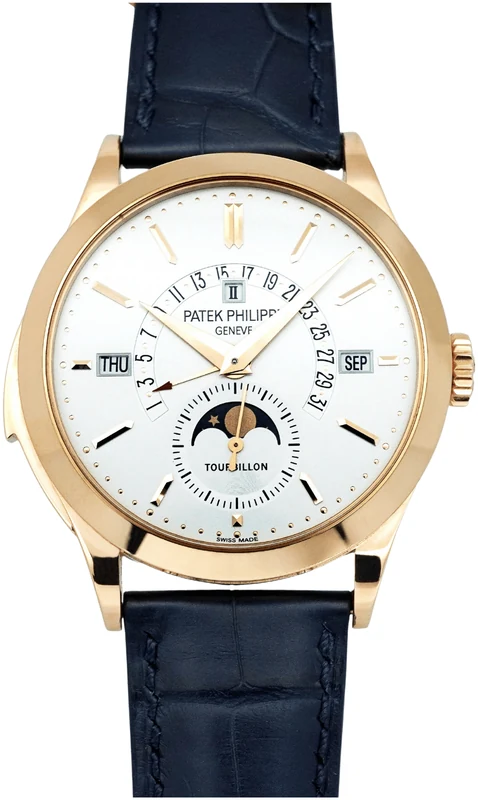
The successor to the discontinued 5101P. A flying tourbillon in a Calatrava case, ten-day power reserve, hours and minutes only. Patek's tourbillon line is deliberately understated. The carriage is visible only through the case back. The argument is that a complication this difficult should not have to advertise itself.
Greubel Forsey Quadruple Tourbillon
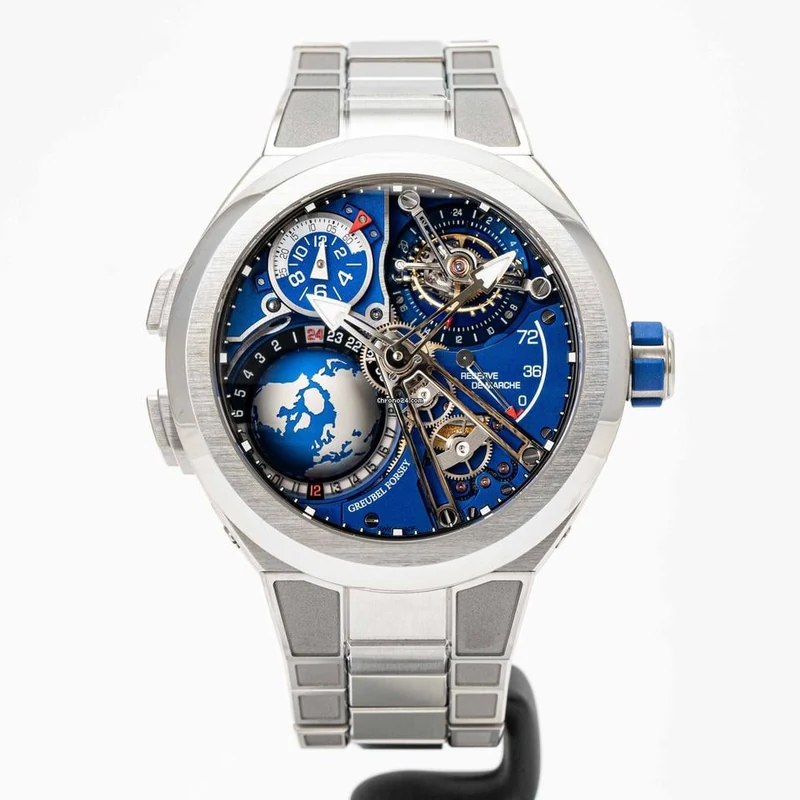
Two pairs of nested cages, rotating in opposite directions on different axes. Robert Greubel and Stephen Forsey founded their Maison in 2004 specifically to push the tourbillon's mechanical limits. Each Quadruple takes around six months to assemble. The Maison produces fewer than 100 watches a year, total, across all references.
Vacheron Constantin Traditionnelle Tourbillon
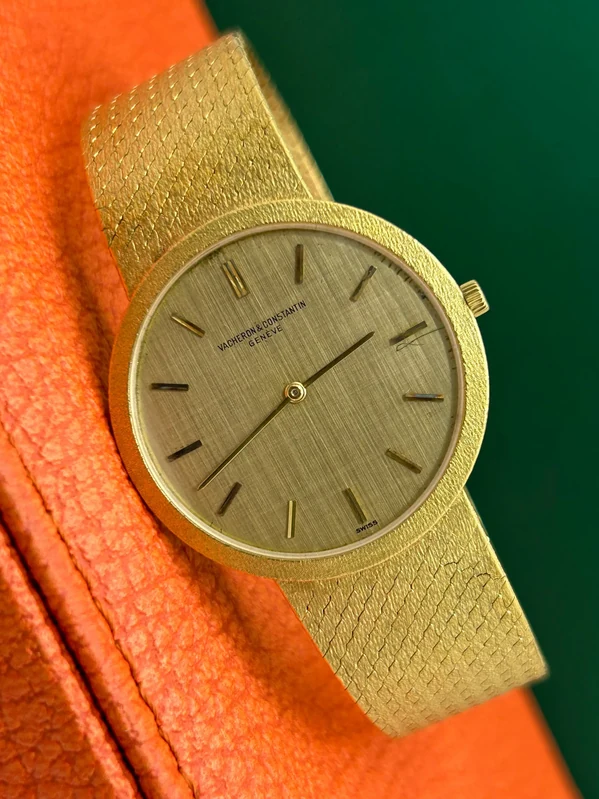
The 41 mm reference 6000T houses the calibre 2160, a 188-component movement, 1 mm slimmer than the typical tourbillon calibre. Hallmark of Geneva, peripheral rotor, 80-hour power reserve. A textbook execution of the conventional form.
F.P. Journe Tourbillon Souverain
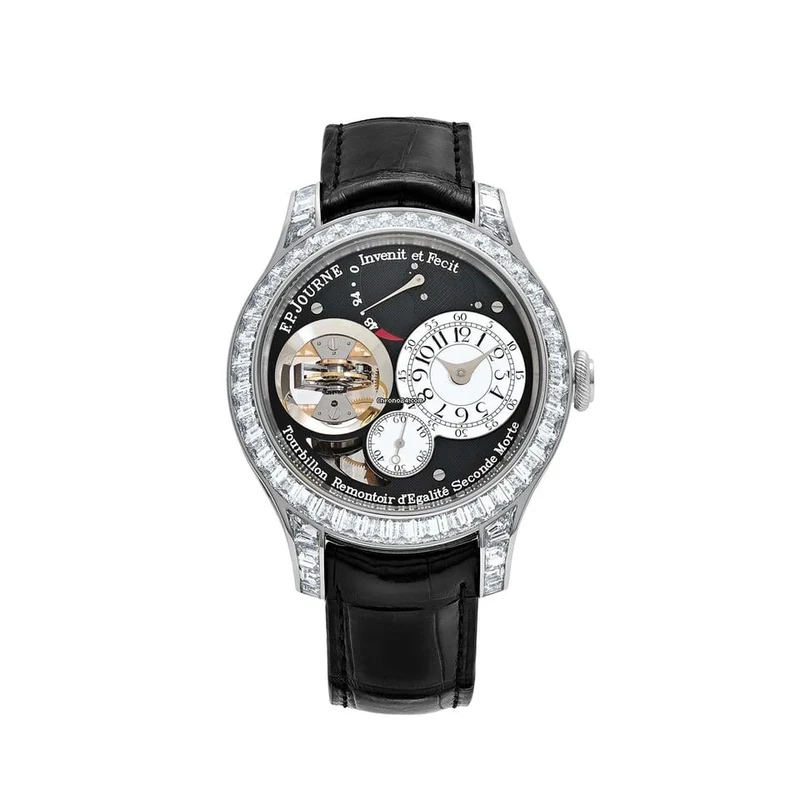
François-Paul Journe's first wristwatch, launched in 1999, brought a remontoire-equipped tourbillon to a non-bridged dead-beat seconds layout. The current Souverain Vertical adds a vertical-axis tourbillon, a signature engineering risk only a small Maison would take.
What a Tourbillon Costs in 2026
The price floor for a Swiss-made tourbillon at a recognised Maison is around CHF 30,000. The ceiling is, in any honest sense, uncapped.
- Entry haute horlogerie. Frédérique Constant, Bulgari Octo Finissimo Tourbillon, Tudor: CHF 25,000-65,000. Industrially produced movements, properly finished, but volume rather than artisanal.
- Established Maisons. Breguet, Vacheron, Audemars Piguet, IWC, Jaeger-LeCoultre: CHF 80,000-300,000 for current-production references.
- Patek Philippe. A modern Patek tourbillon starts around CHF 200,000 and rises rapidly.
- Independents. F.P. Journe, Laurent Ferrier, Voutilainen, Greubel Forsey, De Bethune: CHF 250,000 to over CHF 1 million for current production.
- Auction territory. Vintage Pateks (3939, 3939H, 5101P) trade between USD 350,000 and over USD 2 million depending on metal, condition and provenance. Phillips' 2024 sale of a 1944 Patek 1908 wristwatch with tourbillon set the upper benchmark above USD 7 million.
The Market in Numbers
Industry estimates suggest fewer than one in 750 mechanical watches produced annually contains a tourbillon. The Federation of the Swiss Watch Industry has not published a tourbillon-specific volume figure, but the annualised total across all manufacturers is widely understood to sit between 15,000 and 25,000 pieces a year. By comparison, a single popular Rolex reference can exceed that figure.
Production scarcity, combined with the visibility of the complication on the dial, is what drives both the cultural and monetary premium. A tourbillon is a watch you can identify across a crowded room. Few other complications can claim the same.
Should You Buy One
If accuracy is the goal, the answer is no. A modern Grand Seiko Spring Drive will outperform almost any tourbillon at a fraction of the cost. If the goal is to own a piece of a 224-year-old engineering tradition, made by hand in numbers that sit below those of the rarest exotic cars, the case is harder to dismiss.
The tourbillon has outlived its original purpose by a clear margin. It survives because it is the only mechanical complication that looks like what it does. The cage rotates. The watch keeps time. And on a quiet wrist, in a quiet room, it is still the closest a watch comes to art that moves.
The Takeaway
The tourbillon began as Breguet's solution to vertical positional error. In 2026 it has become the field's clearest signal of artisanal craft, kept alive not by physics but by patience, finishing, and a market that is willing to pay for both. Whether that is worth six figures is a question only the buyer can answer. What is not in question is that the tourbillon, two centuries on, remains the most powerful single image in mechanical watchmaking.

